Park City/Summit County Arts Council profiles Brides of 1941. Read the entire article here.
Founded in 1986, the Park City Summit County Arts Council is one of the oldest arts and culture organizations in Park City.
Park City/Summit County Arts Council profiles Brides of 1941. Read the entire article here.
Founded in 1986, the Park City Summit County Arts Council is one of the oldest arts and culture organizations in Park City.
Picking up the thread of my last blog, think about that cash box moment in January 1981. Was it catastrophic? No. It was akin to being caught with your pants down without an audience. Why? No one clamored outside the festival box office at the Egyptian Theatre that day. In a Band-Aid solution, I retrieved a steel box from my office at the Chamber of Commerce, assembled several denominations of bills to make change, then dashed back to Main Street. With little traffic (and not one traffic light in town) my volunteer helper was set and festival ready.
Fast forward to SUNDANCE, January 2000. I personally steered clear of that millennium chaos. But it’s worth remembering this. Steadfast locals sacrificed a night’s sleep camped outside the box office at the Lower Main Street Plaza. They were the hard-core, celebrated veterans – an original cast of characters who by choice donned thermal underwear and sleeping bags to spend a mid-winter night on a sidewalk in the mountains. In the glory of self-sacrifice, they were rewarded with tickets and stories of hardship.
It was in 2006 when my teenage sons, then sixteen and thirteen, begged for tickets to the American adventure comedy film, The Darwin Awards. I failed them. Acting on the adage “half a loaf is better than none,” I took a wild chance on an unknown documentary. In the eighth row, podium side at the Park City Library venue we watched the world premiere of what would become this Oscar winner: An Inconvenient Truth. Al Gore accompanied by Tipper and family trooped down the south side of the auditorium to debut the game changing film. That was a SUNDANCE moment as Robert Redford intended it; storytelling as the greatest platform for getting people to pay attention and take action.
Each year I recall those snapshot gems like a SUNDANCE sage. Standing shoulder to shoulder in festival cues with like-minded fans of the big screen, they are fun conversation starters. Humble beginnings are often worth sharing, particularly with documentary film fans. They are the ones who will take this thought-provoking message to heart. A quote that plays out in picture and verse with the playful characters in my book, Brides of 1941:
– Dr. Peter Marshall
It was 1977 or thereabouts when I enrolled in a Media Studies class to fulfill a general education requirement at the University of Utah. One choice subject? The “Dollars Trilogy,” Spaghetti Westerns directed by Sergio Leone, starring Clint Eastwood; A Fistful of Dollars (1964), For a Few Dollars More (1965) The Good, the Bad and the Ugly (1966). My amateur movie reviews respectably contemplated lighting, camera placement, symbolism and historical phenomena. It never occurred to me that a person could do that for a living.
In Brides of 1941, Robin (the main character) finds herself in the right place and time in 1939. As I mention in the book, it was one of the most remarkable years in Hollywood history for releasing quality, iconic movies. Robin held her place beneath the cinema marquee, boosting ticket sales for first-run classics: Confessions of a Nazi Spy, It Could Happen to You, Man About Town, Grand Jury Secrets, Daughter’s Courageous, Undercover Doctor, Wife Husband and Friend, and The Wizard of Oz, to name a few.
It’s why Leonard Maltin’s Classic Movie Guide rests on my desk dogeared and highlighted tracking Robin’s path through its pages.
That bit of the past prompts me to pick up on the topic of SUNDANCE, because it’s that time of year in Park City, and I’ve coincidentally been around through iterations of name changes: Utah/U.S. Film Festival, United States Film and Video Festival, Sundance/United States Film Festival to just plain SUNDANCE.
It all started late summer in Salt Lake, 1978 when it was known as the Utah/U.S. Film Festival. Three years later, in January 1981 the fledgling fest opened in Park City, where I lived and worked for the Chamber of Commerce at the time. To move the festival to Park City in the middle of winter was a strategic economic business decision all the way around. It would invite tourism dollars in the (then) post-holiday travel slump and worked equally well as a hook for film industry professionals. Since the 1930s people bought in to the glamour of skiing depicted in cinema. I make this point in Brides: “to discuss the sport, and more importantly to see and be seen doing the sport, defined a person as rather upscale and outdoorsy, then and still today.”
One of my hats at the Chamber was to support special events, often enlisting and organizing volunteers to help. We relied on telephone land lines and kept promises. In 1982, The Egyptian Theatre was the main festival ticket outlet in town. Volunteers were assigned shift by shift. When the box office was scheduled to open, I popped up to Main Street to be sure all was in order. My volunteer helper was there, but helpless. Even though ticket prices were just $3.50 for individual film screenings ($30 for a package of ten), it was impossible to do her job without a cash box.
Bonnie sat down with Randy in early December on the Local View radio show. Here’s the transcript of their lively discussion.
Brides of 1941 is now available from Cahoots gifts and cards near the Park City Market.
When Bonnie Bedford Park discovered a box of letters that her parents and grandparents sent to each other back in the 1930s and 1940s, she had no idea the correspondences would inspire her new book, “Brides of 1941.”
Read the entire interview at The Park Record.
Park City’s local public radio station, KPCW, talks with Bonnie Bedford Park about her book, Brides of 1941, a family history covering three generations of women woven together from letters discovered in the back of a closet.

Welcome to my blog. May I ask if you like museums? If so, you will like it here. My older brother once remarked, “Your house is like a taking a stroll through time.” Point taken. As newlyweds on a shoestring budget, my husband, Pete, and I piece mealed our home décor with distressed mid-twentieth century furniture purchased at auction; a hall tree, a hutch, an icebox, a dough table and mis-matched bedroom sets. Eight years and $800 later a 1942 Dodge Power Wagon followed Pete home like a new puppy. A restoration project he rationalized at the time. A truck he believed our eight-month-old son would drive when he turned sixteen. Top speed 45mph.
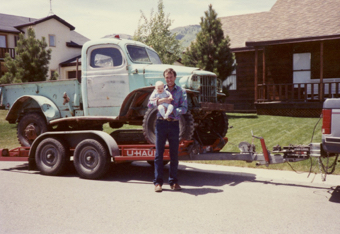
As a new mother, a wise soul once confided in me, “Children are your mark in time.” Every parent eventually comes to understand that universal truth. Then, as the generations that precede us pass, we wake up to the fact the line to the hereafter is suddenly shorter. That’s how it works.
Brides of 1941 reminds us of the elasticity of time. It is a case study that reveals the words, thoughts, deeds and actions of a sampling of twentieth century American families. To quote this letter from my mother to my father: I got the full force of your ideas for the future – one of social justice, equality, and democracy for all, which I never had applied specifically before… Here is a tremendous field for work, dearest.
Nearly eighty years later, how it can be so many fellow Americans and members of the U.S. Congress still question the equality of basic human worth?
My muse? Just when did America get so messy?
I can’t answer it yet, but I have faith our divided country will do better if only because of our children leading with social conscience and scientific fact.
What we know of the Greatest Generation, and world freedoms they fought for, is worth preserving. From letters fashioned into this story we remember our America. And in the restoration of militaria that lived through the action, we will never forget.

In February 1934, T. Wayne and Dr. Lelia Skinner leave their three children behind in North America. Lelia’s hand-wringing letters from “Campamento Americano,” the residential section of a Chilean mining camp, describe an over-worked existence. The Skinners commit to keep up with the expense of three college educations. It is through her candid correspondence Lelia opens the door to an authentic multi-general family saga.
Their eldest daughter, Roberta, lands on the campus of Smith College in 1937. Beaus who rank on Roberta’s “man-score” include a “townie,” several ivy leaguers, and a Montana cowboy. Over Christmas break 1939, in Saint Pete, Florida, she dances with Buster Bedford, a Princeton “Tiger” graduate and Columbia Law School first year. As the Roosevelt administration strategically guides the nation toward U.S. involvement in WWII, Buster prepares himself for the effort while courting Roberta long distance. He implores her to join him in an uncertain future and presses for her hand.
“When cleaning out the personal effects of members of the ‘Greatest Generation,’ it’s not all that uncommon to find boxes of letters,” says Park. Short of pushing them to the back of another closet what do people do with them? “Some suggest to ceremoniously burn them and return their energy back to the universe. Tragically, others choose to declutter them straight to a dumpster.”
Over the course of a few years, Park transcribed her family’s correspondence without giving thought to publishing a book. Though she confesses, “lessons from a conference of personal historians lit up a passion.” A game-changer for Park. The testimony of struggles, hopes, dreams, laughter and fun of real people who are no longer with us is compelling.
“The fact that my husband is an enthusiastic collector of WWII memorabilia also plays a hand in my writing.” The ghosts are afloat in their Park City home where khaki and olive drab dominate the color palate. “It’s like living in a museum,” she laughs.
“I’m a little undone at this moment in history. I appreciate now more than ever the patient teaching moments of Robin and Buster, and how they informed my values.” Civil rights, the second wave of feminism and the Vietnam war dominated dinner table conversation in her childhood home.
The lessons are universal. “We humans are often too quick to judge. Why others hide from uncomfortable conversations with family and friends that we can, and must, learn from.” In Park’s case, anxiety, depression and suicide were woven into the family fabric before mental health mattered enough to dominate headlines.
When asked how her ancestors might feel about sharing their story with the world, Park has this to say. “They may not like it, but I say it’s time for those skeletons to begin the conversation other American families might want to have.”
www.spikypigpress.com
Email: bonnie@spikypigpress.com
Mobile: 435-655-1635